Poland 1968 fight for Freedom Film
http://www.tvpolonia.com/player/index.php?path=58&mov=333935684.wmv&play=1
Friday, April 4, 2008

Poland and Georgia fight for freedom
Poland and Georgia fight for freedom


Poland and Georgia fight for freedom
Georgian Officers Fighting for Poland
by Gia Kandashvili
Georgian Officers Fighting for Poland
by Gia Kandashvili
See
http://www.tvpolonia.com/player/index.php?path=58&mov=87367586.wmv&play=1
W rogatywce i tygrysiej skórze - film dokumentalny - TV Polonia ...Losy gruzińskich oficerów, którzy w czasie II wojny światowej znaleźli się w AK. W Muzeum Powstania Warszawskiego ma powstać ich pomnik.
Originally Published in Georgia Today Newspaper
Last week, Georgia Today learned about a unique work that Jerzy Lubach, a renowned Polish documentary director, friend of Georgia and expert of the Caucasus had taken over. This is a documentary about Georgian officers who fought in the Polish army against the fascist and communist invaders. In the interview, Lubach disclosed a touching story of a Georgian noble diaspora having left a glorious trace in Polish history. Jerzy Lubach, along with his Georgian colleagues, discovered many interesting facts in the recently opened archives of Poland, Georgia and Russia. Since it sounds so interesting, we decided to narrate a bit about the basic story that laid the ground to the idea for the film. First of all, how did Georgian officers find themselves in Poland? Jerzy Lubach willingly answered this and other questions.
Jerzy Lubach
When Georgia gained independence from the Russian Empire, Georgia and Poland launched extensive diplomatic, political and military exchanges। The Polish state envoy, Waclaw Ostrowski, was dispatched to Georgia to set up a Polish diplomatic mission in the fledgling democratic republic. Poland firmly adhered to the policy of establishing close diplomatic relations with the states of the South Caucasus, which had escaped the shadow of Russian rule. Marshal and leader of Poland, Jozef Pilsudski, attached great importance to that strategy. Soon Georgia became a pivotal state as the way to Azerbaijan was cut off because of Bolshevic upheaval there. However, all the plans of fast development of Polish-Georgian relations collapsed with intrusion of the Soviet Red Army in independent Georgia on February 1921. After two weeks of merciless fighting, the tiny Georgian corps was crushed and the Soviet flag was raised in Tbilisi. The state was annexed, and the remainder of the leading Georgian military personnel as well as the temporary government fled to Europe via Batumi and Constantinople. Poland did not recognize the annexation of Georgia and kept close relations with the Georgian political and military authorities in exile. Moreover, in autumn 1921 Marshal Pilsudski’s military attaché in Constantinople, Colonel Babicki, addressed an offer to the chief of the Georgian military headquarters, General Alexander Zakariadze, that Poland was willing to accept Georgian officers in the Polish army. Georgian officers – six generals among them – came to Poland and it was to become their second motherland. According to historical data, they quickly grasped the specifics of the Polish military, perfected their Polish and established close relations with their Polish colleagues. “Although Germany announced free passage from Poland for any foreigners, none of the Georgian officer left the country in September 1939, when the fascist army invaded Polish lands. They heroically battled against the fascist occupants as well as Stalin’s Soviet army,” stressed Jerzy Lubach. Some Georgian officers held high military positions in the Polish army. Colonel Valerian Tevzadze led the northern defense of Warsaw. He later was awarded with the Silver Cross for Military Valor. After the Red Army took over Poland, Valerian Tevzadze joined the Polish underground against the communists until his death 1987. “Many Poles knew about Tevzadze who was just a ‘tidbit’ for both Soviet and Polish KGB, but no one gave him in,” underlined the film director in his talk with Georgia Today. As we learned, the current defense minister of Georgia, David Tevzadze, is a close descendent of Valerian Tevzadze. The minister pledged support to the film crew. “There are many other figures from the ranks of Georgian officers who gained fame in the battle for Poland,” Jerzy Lubach narrated. Major Artemi Aronishidze led the 360th infantry battalion in the defense of Warsaw. “He did not retreat until the surrender of the capital to the fascists.” Aronishidze was soon captured by the Germans, and later handed over to the Soviet KGB. Overall amnesty saved him from capital punishment. The major, who was also awarded the Silver Cross, died at 58, in 1950. Giorgi Tumanishvili was born in Poland, to a family of a Georgian officer in exile. In his youth he joined the Polish army in 1939 and had time for taking part in a number of Polish military campaigns against the fascists. Having gained the rank of captain, he was twice awarded with the Silver Cross for Military Valor. Dimitri Shalikashvili gained the rank of major in Poland. After the fall of Warsaw he escaped to America where his sons managed to reach the highest military positions. John Malkhaz Shalikashvili, the eldest son, was the chief of the united military headquarters of the U.S. for years in the early 90s. The younger brother is now taking active part in the Train and Equip Program conducted by the U.S. government in Georgia. “But, such success stories are very rare. A number of Georgian officers fighting in the Polish army died in Gestapo dungeons or Soviet camps,” the film director sighed. Thus, it is obvious that Jerzy Lubach has got a lot to say about the history of the military fraternity between the two nations. Tamara Dularidze, a lecturer at a Moscow cinematography institute and friend of the Polish director is working along with him. Dularidze and Lubach have a good experience in working together on Georgian-Polish history. The film “Seeking the White Angel”, about Grigol Peradze, a Georgian priest and scientist working in Poland, having been killed by the fascists for treating Polish Jews, deserved a high honor. The documentary about Georgian officers in Poland is to be shot in Georgia, Poland, Great Britain and Russia. The Georgian film studio Grifon Film Productions, under Irakli Metreveli, expressed its willingness to work in partnership with Jerzy Lubach on the film. “I hope to invite John Malkhaz Shalikashvili to work in Warsaw as well,” Jerzy Lubach told Georgia Today. The director is going to re-scrutinize the archive of the first Georgian republic of 1918-1921, which should provide a great deal of material for the film.
Georgian emigration in Poland
From Wikipedia, the free encyclopedia
Jump to: navigation, search
The documented ties between Georgia and Poland reach back to the XV century, when the Georgian (Kartlian) King Konstantin sent a diplomatic mission to the Polish King Alexander Jagellon. Later, Polish King Jan III Sobiesky tried to establish contacts with Georgia. Many Georgians participated in military campaigns led by Poland in XVII century. Bohdan Grudziecki, a Georgian, was the greatest authority on all things Persian working in the Polish king's diplomatic service, made frequent diplomatic trips to Persia, on which he obtained, among other things, guarantees upholding earlier privileges for missionaries. Already during the rule of King Jan Kazimierz was he sent on missions to Isfahan, and King Jan III Sobieski availed himself of Gurdziecki's talents in like manner (in 1668, 1671, 1676-1678, in 1682-1684, and in 1687). Gurdziecki remained at the court of the shah for several years in the capacity of special resident and representative of the Polish king; it was him who delivered to the shah Suleiman news about the victory of the Christian forces at Vienna (1683).
Several Georgian politicians, intellectuals and military officers left Georgia for Poland after the Soviet armies invaded the Democratic Republic of Georgia (DRG) in February 1921, taking over the government and establishing the Georgian Soviet Socialist Republic in the same March. Although not very numerous and consisting of a few hundred members, the Georgian community of Poland was very active politically and culturally. The best remembered are, however, the Georgian military personnel who served in the Polish ranks from the early 1920s until the end of the World War II.
[edit] Georgian Prometheism
Active diplomatic contacts developed between the short-lived DRG and Poland was part of Józef Piłsudski’s well-known political concept known as Prometheism. Its aim was to greatly reduce the power of Tsarist Russia and subsequently, the Soviet Union, by supporting nationalist independence movements of the major non-Russian peoples that lived within the borders of Russia or the Soviet Union.
Polish and Georgian officers serving in the Polish Army, 1925
The Georgian Promethean groups were one of the most active within the movement. This was not overlooked by the Bolsheviks, who in 1930 organized the assassination of Noe Ramishvili, a prominent Georgian political leader and a major promoter of Prometheism.
The 1932 Polish-Soviet mutual nonaggression pact precipitated the downfall of the Promethean movement though the Georgians continued their activities in various cultural and social organizations. The most important was the Committee of Georgia founded as early as 1921 by several Georgian intellectuals led by Sergo Qurulashvili. They had close contacts with the centers of Georgian political emigration across Europe, primarily in Paris. The Committee organized various meetings and social activities and provided material support for the Georgian émigrés. It also published its own publications, ProGeorgia (1922), and Propartia (1923). From 1923 to 1924, Qurulashvili also directed the journal Schlos Wschodu pertaining to the Georgian problems. The Georgians organized also the Union of Georgian Students and the Polish-Georgian Society led by Prince Pavle Tumanishvili. The activities of these organizations were limited, however, due to financial difficulties.
[edit] Georgians in the Polish military service
Major Giorgi Mamaladze, later murdered in the 1940 Katyn massacre
Immediately after the fall of the DRG, Noe Zhordania, the head of the Georgian government-in-exile, addressed the friendly nations, particularly France, Greece and Poland, to help in maintaining the professional military cadres. The government of Poland promptly responded, and from 1922 to 1924, hundreds of Georgian Junkers and officers, recommended by Zhordania’s government, were accepted in the Polish military schools. Several professional officers of the former DRG attended military training courses at the Polish army centers. Although not obligated to do so, virtually all of them were subsequently enrolled in the Polish army as contract officers. In the subsequent decade, the total number of Georgian military servicemen reached 1,000.
At the outbreak of the World War II, most of the Georgian officers took part in the 1939 Defensive War, and several of them commanded their own regiments composed of Polish soldiers. The most notable officers were:
Zakaria Bakradze, generał dywizji, deputy commander of Polish 15th Infantry Division.
Aleksandre Chkheidze, generał brygady, deputy commander of Polish 16th Infantry Division.
Ivane Kazbegi, generał brygady.
Aleksandre Koniashvili, generał brygady.
Kirile Kutateladze, generał brygady.
Aleksandre Zakariadze, generał brygady.
Viktor Lomidze, the commander of ORP Gryf.
Giorgi Tumanishvili, captain of the navy, who was awarded Virtuti Militari.
Valerian Tevzadze, podpułkownik, the commander of the northern sector of the Polish defences during the siege of Warsaw.
Mikheil Kvaliashvili, major, the commander of a cavalry battalion within the 15th Uhlans Regiment.
Several Georgian officers were captured by the Soviet forces during the 1939 campaign. General Chkheidze, Major Mamaladze, Captain Skhirtladze and Captain Rusiashvili were killed during the infamous Katyn Massacre, from 1940 to 1941. Many others spent several years in the gulag camps.
St. Grigol Peradze
During the occupation of Poland, the Germans reorganized the Warsaw-based Committee of Georgia and placed it under their tight control. The occupation administration encouraged the Georgian soldiers in the Polish service to join the Georgian Legion of the Wehrmacht. Some of them responded to the Nazi request, but subsequently joined the Polish resistance movement. The notable Georgian Orthodox priest and Professor Grigol Peradze of Warsaw University ended his life in the Auschwitz concentration camp (1942), when he deliberately entered a gas-chamber instead of a Jewish prisoner who had a large family.
John Malchase David Shalikashvili, general of the United States Army who served as Chairman of the Joint Chiefs of Staff from 1993 to 1997, was born in Warsaw, Poland where his father also served in the army.
After the war, most Georgians either left for Western Europe or were deported to the Soviet camps though some of them (e.g., General V. Tevzadze) remained in the Polish anti-Communist underground for several decades.
http://www.tvpolonia.com/player/index.php?path=58&mov=87367586.wmv&play=1
W rogatywce i tygrysiej skórze - film dokumentalny - TV Polonia ...Losy gruzińskich oficerów, którzy w czasie II wojny światowej znaleźli się w AK. W Muzeum Powstania Warszawskiego ma powstać ich pomnik.
Originally Published in Georgia Today Newspaper
Last week, Georgia Today learned about a unique work that Jerzy Lubach, a renowned Polish documentary director, friend of Georgia and expert of the Caucasus had taken over. This is a documentary about Georgian officers who fought in the Polish army against the fascist and communist invaders. In the interview, Lubach disclosed a touching story of a Georgian noble diaspora having left a glorious trace in Polish history. Jerzy Lubach, along with his Georgian colleagues, discovered many interesting facts in the recently opened archives of Poland, Georgia and Russia. Since it sounds so interesting, we decided to narrate a bit about the basic story that laid the ground to the idea for the film. First of all, how did Georgian officers find themselves in Poland? Jerzy Lubach willingly answered this and other questions.
Jerzy Lubach
When Georgia gained independence from the Russian Empire, Georgia and Poland launched extensive diplomatic, political and military exchanges। The Polish state envoy, Waclaw Ostrowski, was dispatched to Georgia to set up a Polish diplomatic mission in the fledgling democratic republic. Poland firmly adhered to the policy of establishing close diplomatic relations with the states of the South Caucasus, which had escaped the shadow of Russian rule. Marshal and leader of Poland, Jozef Pilsudski, attached great importance to that strategy. Soon Georgia became a pivotal state as the way to Azerbaijan was cut off because of Bolshevic upheaval there. However, all the plans of fast development of Polish-Georgian relations collapsed with intrusion of the Soviet Red Army in independent Georgia on February 1921. After two weeks of merciless fighting, the tiny Georgian corps was crushed and the Soviet flag was raised in Tbilisi. The state was annexed, and the remainder of the leading Georgian military personnel as well as the temporary government fled to Europe via Batumi and Constantinople. Poland did not recognize the annexation of Georgia and kept close relations with the Georgian political and military authorities in exile. Moreover, in autumn 1921 Marshal Pilsudski’s military attaché in Constantinople, Colonel Babicki, addressed an offer to the chief of the Georgian military headquarters, General Alexander Zakariadze, that Poland was willing to accept Georgian officers in the Polish army. Georgian officers – six generals among them – came to Poland and it was to become their second motherland. According to historical data, they quickly grasped the specifics of the Polish military, perfected their Polish and established close relations with their Polish colleagues. “Although Germany announced free passage from Poland for any foreigners, none of the Georgian officer left the country in September 1939, when the fascist army invaded Polish lands. They heroically battled against the fascist occupants as well as Stalin’s Soviet army,” stressed Jerzy Lubach. Some Georgian officers held high military positions in the Polish army. Colonel Valerian Tevzadze led the northern defense of Warsaw. He later was awarded with the Silver Cross for Military Valor. After the Red Army took over Poland, Valerian Tevzadze joined the Polish underground against the communists until his death 1987. “Many Poles knew about Tevzadze who was just a ‘tidbit’ for both Soviet and Polish KGB, but no one gave him in,” underlined the film director in his talk with Georgia Today. As we learned, the current defense minister of Georgia, David Tevzadze, is a close descendent of Valerian Tevzadze. The minister pledged support to the film crew. “There are many other figures from the ranks of Georgian officers who gained fame in the battle for Poland,” Jerzy Lubach narrated. Major Artemi Aronishidze led the 360th infantry battalion in the defense of Warsaw. “He did not retreat until the surrender of the capital to the fascists.” Aronishidze was soon captured by the Germans, and later handed over to the Soviet KGB. Overall amnesty saved him from capital punishment. The major, who was also awarded the Silver Cross, died at 58, in 1950. Giorgi Tumanishvili was born in Poland, to a family of a Georgian officer in exile. In his youth he joined the Polish army in 1939 and had time for taking part in a number of Polish military campaigns against the fascists. Having gained the rank of captain, he was twice awarded with the Silver Cross for Military Valor. Dimitri Shalikashvili gained the rank of major in Poland. After the fall of Warsaw he escaped to America where his sons managed to reach the highest military positions. John Malkhaz Shalikashvili, the eldest son, was the chief of the united military headquarters of the U.S. for years in the early 90s. The younger brother is now taking active part in the Train and Equip Program conducted by the U.S. government in Georgia. “But, such success stories are very rare. A number of Georgian officers fighting in the Polish army died in Gestapo dungeons or Soviet camps,” the film director sighed. Thus, it is obvious that Jerzy Lubach has got a lot to say about the history of the military fraternity between the two nations. Tamara Dularidze, a lecturer at a Moscow cinematography institute and friend of the Polish director is working along with him. Dularidze and Lubach have a good experience in working together on Georgian-Polish history. The film “Seeking the White Angel”, about Grigol Peradze, a Georgian priest and scientist working in Poland, having been killed by the fascists for treating Polish Jews, deserved a high honor. The documentary about Georgian officers in Poland is to be shot in Georgia, Poland, Great Britain and Russia. The Georgian film studio Grifon Film Productions, under Irakli Metreveli, expressed its willingness to work in partnership with Jerzy Lubach on the film. “I hope to invite John Malkhaz Shalikashvili to work in Warsaw as well,” Jerzy Lubach told Georgia Today. The director is going to re-scrutinize the archive of the first Georgian republic of 1918-1921, which should provide a great deal of material for the film.
Georgian emigration in Poland
From Wikipedia, the free encyclopedia
Jump to: navigation, search
The documented ties between Georgia and Poland reach back to the XV century, when the Georgian (Kartlian) King Konstantin sent a diplomatic mission to the Polish King Alexander Jagellon. Later, Polish King Jan III Sobiesky tried to establish contacts with Georgia. Many Georgians participated in military campaigns led by Poland in XVII century. Bohdan Grudziecki, a Georgian, was the greatest authority on all things Persian working in the Polish king's diplomatic service, made frequent diplomatic trips to Persia, on which he obtained, among other things, guarantees upholding earlier privileges for missionaries. Already during the rule of King Jan Kazimierz was he sent on missions to Isfahan, and King Jan III Sobieski availed himself of Gurdziecki's talents in like manner (in 1668, 1671, 1676-1678, in 1682-1684, and in 1687). Gurdziecki remained at the court of the shah for several years in the capacity of special resident and representative of the Polish king; it was him who delivered to the shah Suleiman news about the victory of the Christian forces at Vienna (1683).
Several Georgian politicians, intellectuals and military officers left Georgia for Poland after the Soviet armies invaded the Democratic Republic of Georgia (DRG) in February 1921, taking over the government and establishing the Georgian Soviet Socialist Republic in the same March. Although not very numerous and consisting of a few hundred members, the Georgian community of Poland was very active politically and culturally. The best remembered are, however, the Georgian military personnel who served in the Polish ranks from the early 1920s until the end of the World War II.
[edit] Georgian Prometheism
Active diplomatic contacts developed between the short-lived DRG and Poland was part of Józef Piłsudski’s well-known political concept known as Prometheism. Its aim was to greatly reduce the power of Tsarist Russia and subsequently, the Soviet Union, by supporting nationalist independence movements of the major non-Russian peoples that lived within the borders of Russia or the Soviet Union.

Polish and Georgian officers serving in the Polish Army, 1925
The Georgian Promethean groups were one of the most active within the movement. This was not overlooked by the Bolsheviks, who in 1930 organized the assassination of Noe Ramishvili, a prominent Georgian political leader and a major promoter of Prometheism.
The 1932 Polish-Soviet mutual nonaggression pact precipitated the downfall of the Promethean movement though the Georgians continued their activities in various cultural and social organizations. The most important was the Committee of Georgia founded as early as 1921 by several Georgian intellectuals led by Sergo Qurulashvili. They had close contacts with the centers of Georgian political emigration across Europe, primarily in Paris. The Committee organized various meetings and social activities and provided material support for the Georgian émigrés. It also published its own publications, ProGeorgia (1922), and Propartia (1923). From 1923 to 1924, Qurulashvili also directed the journal Schlos Wschodu pertaining to the Georgian problems. The Georgians organized also the Union of Georgian Students and the Polish-Georgian Society led by Prince Pavle Tumanishvili. The activities of these organizations were limited, however, due to financial difficulties.
[edit] Georgians in the Polish military service

Major Giorgi Mamaladze, later murdered in the 1940 Katyn massacre
Immediately after the fall of the DRG, Noe Zhordania, the head of the Georgian government-in-exile, addressed the friendly nations, particularly France, Greece and Poland, to help in maintaining the professional military cadres. The government of Poland promptly responded, and from 1922 to 1924, hundreds of Georgian Junkers and officers, recommended by Zhordania’s government, were accepted in the Polish military schools. Several professional officers of the former DRG attended military training courses at the Polish army centers. Although not obligated to do so, virtually all of them were subsequently enrolled in the Polish army as contract officers. In the subsequent decade, the total number of Georgian military servicemen reached 1,000.
At the outbreak of the World War II, most of the Georgian officers took part in the 1939 Defensive War, and several of them commanded their own regiments composed of Polish soldiers. The most notable officers were:
Zakaria Bakradze, generał dywizji, deputy commander of Polish 15th Infantry Division.
Aleksandre Chkheidze, generał brygady, deputy commander of Polish 16th Infantry Division.
Ivane Kazbegi, generał brygady.
Aleksandre Koniashvili, generał brygady.
Kirile Kutateladze, generał brygady.
Aleksandre Zakariadze, generał brygady.
Viktor Lomidze, the commander of ORP Gryf.
Giorgi Tumanishvili, captain of the navy, who was awarded Virtuti Militari.
Valerian Tevzadze, podpułkownik, the commander of the northern sector of the Polish defences during the siege of Warsaw.
Mikheil Kvaliashvili, major, the commander of a cavalry battalion within the 15th Uhlans Regiment.
Several Georgian officers were captured by the Soviet forces during the 1939 campaign. General Chkheidze, Major Mamaladze, Captain Skhirtladze and Captain Rusiashvili were killed during the infamous Katyn Massacre, from 1940 to 1941. Many others spent several years in the gulag camps.

St. Grigol Peradze
During the occupation of Poland, the Germans reorganized the Warsaw-based Committee of Georgia and placed it under their tight control. The occupation administration encouraged the Georgian soldiers in the Polish service to join the Georgian Legion of the Wehrmacht. Some of them responded to the Nazi request, but subsequently joined the Polish resistance movement. The notable Georgian Orthodox priest and Professor Grigol Peradze of Warsaw University ended his life in the Auschwitz concentration camp (1942), when he deliberately entered a gas-chamber instead of a Jewish prisoner who had a large family.
John Malchase David Shalikashvili, general of the United States Army who served as Chairman of the Joint Chiefs of Staff from 1993 to 1997, was born in Warsaw, Poland where his father also served in the army.
After the war, most Georgians either left for Western Europe or were deported to the Soviet camps though some of them (e.g., General V. Tevzadze) remained in the Polish anti-Communist underground for several decades.
Tuesday, April 1, 2008
Monday, March 24, 2008
A real hero - Witold Pilecki - A Volunteer for Auschwitz
A real hero - Witold Pilecki - A Volunteer for Auschwitz


A real hero - Witold Pilecki - A Volunteer for Auschwitz
Pilecki i Anders
("Let's Reminisce About Witold Pilecki")
Witold Pilecki was born in Poland in 1901. When the German Army invaded the country in September, 1939, Pilecki joined the Tajna Armia Polska, the Secret Polish Army.
When Pilecki discovered the existence of Auschwitz, he suggested a plan to his senior officers. Pilecki argued he should get himself arrested and sent to the concentration camp. He would then send out reports of what was happening in the camp. Pilecki would also explore the possibility of organizing a mass break-out.
Pilecki's colonel eventually agreed and after securing a false identity as Tomasz Serafinski, he arranged to be arrested in September, 1940. As expected he was sent to Auschwitz where he became prisoner 4,859. His work consisted of building more huts to hold the increased numbers of prisoners.
Pilecki soon discovered the brutality of the Schutz Staffeinel (SS) guards. When one man managed to escape on 28th October 1940, all the prisoners were forced to stand at attention on the parade-ground from noon till nine in the evening. Anyone who moved was shot and over 200 prisoners died of exposure. Pilecki was able to send reports back to the Tajna Armia Polska explaining how the Germans were treating their prisoners. This information was then sent to the foreign office in London.
In 1942 Pilecki discovered that new windowless concrete huts were being built with nozzles in their ceilings. Soon afterwards he heard that that prisoners were being herded into these huts and that the nozzles were being used to feed cyanide gas into the building. Afterwards the bodies were taken to the building next door where they were cremated.
Pilecki got this information to the Tajna Armia Polska who passed it onto the British foreign office. This information was then passed on to the governments of other Allied countries. However, most people who saw the reports refused to believe them and dismissed the stories as attempts by the Poles to manipulate the military strategy of the Allies.
In the autumn of 1942, Jozef Cyrankiewicz, a member of the Polish Communist Party, was sent to Auschwitz. Pilecki and Cyrankiewicz worked closely together in organizing a mass breakout. By the end of 1942 they had a group of 500 ready to try and overthrow their guards.
Four of the inmates escaped on their own on 29th December, 1942. One of these men, a dentist called Kuczbara, was caught and interrogated by the Gestapo. Kuczbara was one of the leaders of Pilecki's group and so when he heard the news he realized that it would be only a matter of time before the SS realized that he had been organizing these escape attempts.
Pilecki had already arranged his escape route and after feigning typhus, he escaped from the hospital on 24th April, 1943. After hiding in the local forest, Pilecki reached his unit of the Tajna Armia Polska on 2nd May. He returned to normal duties and fought during the Warsaw Uprising in the summer of 1944. Although captured by the German Army he was eventually released by Allied troops in April, 1945.
After the Second World War Pilecki went to live in Poland.The Polish Secret Police had him executed in 1948. It is believed that this was a result of his anti-communist activities.
Only Ghosts And Echoes -
Posted by Felis in Heroes, History (Sunday February 12, 2006 at 5:03 pm)
I learnt about Witold Pilecki only by accident, when my maternal grandfather dropped his name while talking about his former associate and the then Polish Prime Minister Jozef Cyrankiewicz.
- Cyrankiewicz, he said, could have saved Pilecki but of course his own heroic tale could have been ruined.
I started asking my grandfather additional questions and learnt a few things about this man, Witold Pilecki, who according to my grandfather’s patchy story, volunteered to go to Auschwitz to gather intelligence for the Home Army (Polish Military Underground Organization) operating during the German occupation.
It was, I think, 1967 and Witold Pilecki as far as the communist authorities were concerned, officially never existed.
My grandfather knew Jozef Cyrankiewicz because both of them were members of PPS -Polish Socialist Party before WWII (PPS was a social-democratic party). Cyrankiewicz was captured and sent by the Germans to Auschwitz in 1942 but my grandfather was saved from being captured by his new identity supported by false documents. After the war, most of the members of PPS accepted the communists’ offer to join the Soviet bandwagon in exchange for good positions within the new administration and sometimes because they weren’t sure what might happen to them if they refused.
This move gave the communists more legitimacy among Western countries as well as the desperate Polish nation.
Or so they thought.
The communist party members were mostly imported from the Soviet Union.
These people, officially Polish, very often could not speak the language and like the first President Boleslaw Bierut were full time NKVG (Soviet Security) employees (the real Polish communist who ended up in Russia after 1939 were mostly executed by Stalin in the 40’s).
And so PPS and PPR (Polish Worker’s Party) were amalgamated into PZPR (Polish United Worker’s Party).
My grandpa was one of those scoundrels, who joined the new organization and for the rest of his life tried to convince himself that his decision was morally justified. He never really made it to the “top†and that is probably why he felt resentment towards Cyrankiewicz for not assisting his old comrades a little bit harder.This is how I learnt about Witold Pilecki for the first time. My grandfather made bitter comments about Cyrankiewicz’s duplicity.
I digress.
I started searching for some more information about Pilecki and slowly a picture emerged, which as much as it was depressing, gave me the feeling of faith in certain moral values, which I thought were long time dead.
Witold Pilecki was rehabilitated only in 1991 and so as I was searching a few days ago for some extra materials about him, I discovered this Wikipedia entry.
There are more sources available on line but because most of them are in Polish, I decided to quote and to translate some additional and interesting aspects of Pilecki’s life story to pay a tribute to the man, who I think, deserves much more recognition.
It was 1940 the Secret Polish Army received conflicting reports about this “new facility†being built and expanded by the Germans in Auschwitz (Oswiecim in Polish) near Kraków.The commanders of the underground, secret army were also receiving requests from the Polish Government, in exile in London; to investigate and to report about German activities around Auschwitz as the unconfirmed rumors about atrocities taking place there reached the allied forces. Witold Pilecki, a lieutenant in the underground army, was the man who volunteered to Auschwitz.
Witold Pilecki was born in 1901 in Oluniec in Russia, where his family was exiled for taking part in the 1863 uprising against Russian occupation of Poland. In 1910 his family moved back into the remains of their property (Pilecki family were small gentry-landowners) near Wilno (today Vilnius). In 1918, he volunteered for the Polish Army that was being formed at that time, and then fought in the Polish-Bolshevik War of 1920.
Witold Pilecki in his cavalry uniform
In 1921 Pilecki took leave from the army to pass his High School Certificate exams (Matura). He attempted studying fine arts at the Stefan Batory University for a while.
Finally, he finishes Military school of Cavalry Reserve in Grudziadz and after being transferred to the Army Reserve as a second lieutenant, he takes over the farm management in his family property in Sukurcze in 1926. He lived and worked in Sukurcze until the outbreak of WWII. These were the happiest years of his life.
Witold Pilecki in before WWII
In 1931 Pilecki married Marianna Ostrowska, a teacher from Masovia. They had two children, a son Andrew and daughter Zofia. In the September campaign of 1939, Pilecki fought as a member of the “Prusy†army group. In November after the collapse of Polish defenses, he helped to found the Secret Polish Army, where he served as the Chief of Staff. In August 1940 Pilecki volunteered to infiltrate Germany’s Auschwitz Concentration Camp at Oswiecim
with the following objectives in mind:
Setting up of a secret organization within the camp to:
Provide extra food and distribute clothing among organization members.
Keep up the morale among fellow inmates and supply them with news from the
outside.
Preparing a task force to take over the camp in the eventuality of the
dropping of arms or of a live force (e.g. paratroops).
Report all of the above to the Secret Army headquarters
On September 19, 1940, with the permission of his commanding officers, he intentionally allowed himself to be captured by the Germans during a round-up in Warsaw’s suburb Zoliborz.
He arrived at Auschwitz at 10 P.M. on September 21, 1940, in the “second†Warsaw transport, under the name Tomasz Serafinski. He was registered as number 4859.
Â
Oswiecim - Pilecki’s mug shot
Â
Fragment of Pilecki’s diary (1) translated from Polish:
They made us run straight ahead towards the thicker concentration of lights. Further towards the destination (the SS troopers) ordered one of us to run to the pole on the side of the road and immediately a series from a submachine gun was sent after him.
Dead.
Ten other inmates were pulled out at random from the marching column and shot with pistols while still running to demonstrate to us the idea of “collective reprisal†if an escape was attempted by any one of us (in this case it was all arranged by the SS troopers).
They pulled all eleven corpses by ropes attached to just one leg. Dogs baited the blood soaked bodies.
All of it was done with laughter and jeering.
We were closing to the gate, an opening in the line of fences made of wire.
There was a sign at the top: “Arbeit macht frei†(Through Work To Freedom).
Only later we could fully appreciate its real meaning.
Pilecki survived his first days in Auschwitz and later established the first cell of his secret organization.
Fragment of Pilecki’s diary (2) translated from Polish:
From the darkness, from above the camp’s kitchen, Seidler the butcher spoke to us: †Do not even dream that any one of you will get out of here alive.
Your daily food ratio is intended to keep you alive for 6 weeks; whoever lives longer it’s because he steals and those who steal will be placed in SK, where nobody lives for too long.â€
Wladyslaw Baworowski - the camp’s interpreter translated it to us into Polish.
SK (Straf-Kompanie - Penal Company).
This unit was designated for all Jews, Catholic priests and those Poles whose “offencesâ€
were proven. Ernst Krankemann, the Block Commander, had a duty of finishing off as many prisoners of the unit as he possibly could to make room for new, daily “arrivalsâ€.
This duty suited Krankemann’s character very well.
If someone accidentally moved just little bit too much from the row of prisoners, Krankemann stabbed him with his knife, which he always carried in his right sleeve.
If someone, afraid of making this mistake, positioned himself slightly too far behind, he would be stabbed by the butcher in the kidney.
The sight of a falling human being, kicking his legs and moaning aggravated Krankemann.
He would jump straight away on the victim’s rib cage, kicked his kidneys and genitals, and finished him off as quickly as possible.
In ‘The Polish Underground Movement in Auschwitz’ Garlinski says:.
Pilecki’s secret organization, which he called the ‘Union of Military Organization’, was composed of cells of five prisoners who were unknown to one another with one man designated to be their commander.
These cells were to be found mainly in the camp hospital and camp work allocation office.
Once the first cells were established, contact with Warsaw became essential.
It so happened that at the time, by exceptionally fortuitous circumstances, a prisoner was released from the camp who was able to take Pilecki’s first report. Later reports were smuggled out by civilian workers employed in the camp. Another means was through prisoners who had decided to escape.
From the very start Pilecki’s principal aim was to take over Auschwitz concentration camp and free all the prisoners. He envisaged achieving this by having Home Army detachments attacking from the outside while cadre members of his Union of Military Organization, numbering around a thousand prisoners, would start a revolt from within. All his reports primarily concerned this matter. However, the Home Army High Command was less optimistic and did not believe such an operation to be viable while the Eastern Front was still far away.
In his diary Pilecki didn’t give the SS troopers much credit, and was certain that his organization could have taken control of the camp.
He waited for orders from the headquarters but at the same time the Germans started arresting members of Pilecki’s secret organization and he knew his time was up.
He also believed that if he could present “his case†in person some action would be taken.
Pilecki therefore felt it necessary to present his plans personally. This meant that he would have to escape from the camp, which he succeeded in doing with two other prisoners on 27th April 1943. Before the breakout Pilecki passed on his position within the camp organization to fellow inmate Henryk Bartoszewicz. However, neither his subsequent report nor the fact that he presented it in person altered the high command’s decision.
Fearing the reprisals on the entire Polish population was one of the reasons why such action was not allowed by the high command in London.
Another one was that there was no way to hide or to move such enormous number of people anywhere and with the Eastern Front still far away the whole project was considered unrealistic.
Witold Pilecki escaped from Auschwitz on the Easter Monday 1943, he also survived the Warsaw Uprising an the German POW camp in Germany.
He returned to Poland after the war and started organizing resistance
against the communists.
When he learnt that the Allies would not help to liberate Poland from the Soviets he started demobilizing the military underground organization.
It was then, that the communists arrested him.
Â
Pilecki - communist jail mug shots
Â
He was interrogated and tortured for many months. His finger nails were pulled out and his collarbones broken and he could hardly walk.
He never “talkedâ€.
After his process, which was a simple farce, he was sentenced to death by a firing squad.
There was no firing squad though.
The executioners dragged him the basement of the Security Headquarters building, into the boiler room.
He was gagged and could not walk.
They shot him with a single slug into the back of his head. He was buried somewhere on the rubbish tip next to the Powazki Cemetery.
His body was never found.
Sunday, March 23, 2008
HOME ARMY and WARSAW UPRISING
HOME ARMY and WARSAW UPRISING INDEX: 1939-1942; Beginning of Secret Army; the ZWZ period 1942-1943; Home Army (AK) in Underground War 1944-1945; "Tempest". Warsaw Uprising. Dissolution of AK Notes and Links
1939 - 1942; THE BEGINNING OF A SECRET ARMY. THE "ZWZ" PERIOD
The failed September campaign in 1939 and the division of Poland into two occupied zones, German and Soviet, did not break the will of the Polish people to continue its fight for freedom.In Warsaw, before the surrender, a secret military organization was set up with the approval of the Supreme Commander, who was already in Romania. General Michael Karszewicz-Tokarzewski took command and gave it the name "Słuźba Zwycięstwu Polski" (Service for Poland's Victory), or "SZP". In addition, both in Warsaw and in other places in the country, many other secret groups sprang up. Some were organized by army officers, who had avoided being taken prisoner, others were initiated by groups from political parties or by groups of friends.
SZP immediately sought for ways to cooperate with the political parties, which had been in opposition to the government before September 1939, but which now had become the base of the Polish Coalition Government, which was formed in France. A Head Council is formed at SPZ command center, which consists of representatives of three Polish parties - the Polish Socialist Party, the Peasant Party (Partia Ludowa) and the National Party. The new Polish Government, now situated in Angers near Paris, in December 1939 created "Związek Walki Zbrojnej - (ZWZ)" (Union for Armed Struggle) with the " aim of creating centers of national resistance " and "rebuilding the Polish nation through armed struggle ". The ZWZ was based on the organizational network of the SPZ. Col. Stefan Rowecki was named ZWZ Commander for the area of German occupation and based in Warsaw; Gen. Tokarzewski was named Commander for the Soviet occupied area. Trying to cross the border between zones in March 1940, Gen Tokarzewski was arrested and taken deep into Russia.
Decrees of the Polish Government stipulated that ZWZ is "universal, national, non-party and non-class " and that it would include all Poles wishing to fight against the occupants. They further stipulated that ZWZ is "a secret military organization, based on strict principles of hierarchy and discipline." The decrees called upon all similar organizations in the country to subordinate themselves to the ZWZ Commanders appointed by the Supreme Commander. Joining the ZWZ required taking an oath of obedience and secrecy. The Head Council functioning at the SPZ was transformed into the "Polityczny Komitet Porozumiewawczy - (PKP)," (Political Coordinating Committee), enlarged by the addition of representatives of the Labor Party (Partia Pracy). Kazimierz Pużak, of the Polish Socialist Party, was elected Chairman of the Committee.
After the fall of France in June 1940, the Polish Government moved to London and established the Supreme Command of the ZWZ in Poland. Gen. Rowecki, in Warsaw, was appointed Commander-in-Chief, to be solely in charge of military matters. At the government-in-exile a Ministerial Committee for Homeland Affairs was set up. Authority in Poland was thus split between military and civil. The position of Chief Government Delegate was established to be In charge of political and administrative affairs in Poland, who was to deal with political matters in consultation with the party representatives in the Political Coordinating Committee. At the end of 1940 the President of Poland (located in London) appointed Cyryl Ratajski, a member of the Labor Party, as Chief Government Delegate. Immediately the task of preparing a working organization, the so called "Delegatura."
During the years 1939-1941, the main efforts of the ZWZ were directed towards organizational work preparing for later military action. During this period a large number of the independent military groups, that had sprung up after September 1939, were incorporated into ZWZ. At the same time ZWZ was fighting the occupants on three fronts: propaganda, reconnaissance and sabotage. Informational and propaganda activity consists of printing secret bulletins, periodicals and news-sheets which were widely distributed among the population. In addition to the publications of ZWZ and the Delegatura, political parties and various ad-hoc groups were also distributing secret literature. ZWZ was carrying out intelligence activities in occupied Poland as well as in Germany itself. It obtains and sends to London a series of important information, the most important being about the preparations for a German attack against the Soviet Union. ZWZ warned that this attack would come in June 1941; in fact it started June 22. Sabotage activities were directed primarily against economic targets that contributed to the German war effort, industry and transportation. The development of ZWZ was not equally successful in all areas of Poland. In central Poland, which had been made into a separate administrative entity called the "General-Gouvernment" with its capital in Cracow, organization moved along rapidly and work was carried out successfully as planned. The western part of Poland had been incorporated directly into the German Reich, work was much more difficult, better results being obtained in the area of Łódż and Silesia than elsewhere. In eastern Poland the strong Soviet political-police controlled occupation created difficulties that were almost impossible to overcome. In south-eastern Poland, around Lvov, organizational attempts were frequently infiltrated by Soviet spies. In north-eastern Poland, around Vilno and Bialystok efforts were more successful. After the German offensive, these areas fell under strict military and SS control. In early 1942, in the north-east Soviet guerilla units spent as much time fighting Polish units as they did the German enemy. In the south-east, Ukrainian nationalism developed with a strong anti-Polish bias, abetted by the Germans. Consequently, the area of the "General-Gouvernment" was the most fruitful base for conspiratorial activity and planning for a general uprising towards the end of the war.
Return to Top of page.
1942 - 1943: HOME ARMY (AK) IN UNDERGROUND WAR
After Gen. Sosnkowski resigned from the government-in-exile in July 1941 (protesting the Polish-Soviet Military Convention), The Supreme Commander Gen. Sikorski placed ZWZ under his direct control. He issued an order 0n February 14,1942 changing the ZWZ into the "Armia Krajowa - AK" (Home Army), with Gen. Rowecki as Commander. During 1942-43 the unifying campaign had made great progress. The "Narodowa Organizacja Wojskowa" of the National Party and the "Peasant Battalions" of the Peasant Party both subordinated themselves to the command of the Home Army. Now the total number of sworn in members of the AK exceeded 300,000.
With the unqualified support of the civilian population, AK was able to develop increased activities. Secret meetings in small groups allowed stepped up training in accordance with the plans for a future uprising. Secret schools trained officer cadets and non-coms. The development of secret factories of weapons, ammunition and other materials proceeded fast. Radio methods were improved and provided for daily communications between the Home Army Commander and the Chief Delegate and their counterparts in England. The Supreme Commander was able to arrange for air supply from the West to Poland of weapons, and trained specialists for various functions in AK. The Intelligence Service of AK was able to monitor the German army and air force on the Eastern Front, and extended its activities to industry and ports in the Reich. An important success was providing information about the German rocket research in Peenemunde which lead to the successful air-raid of 17-18 August 1943. The diversionary propaganda action among Germans, that had started in 1941, was increased. Its aim was to create confusion and pessimism among the troops and officials of the administration. With London's approval, plans for the future general uprising were prepared. At the same time rules were established for the use of women in the Home Army and in the security forces during the uprising. Gen. Rowecki's ideas about active defense against the occupant included sabotage of all its activities that damaged the economy and the lives of the Polish population. A higher degree of active defense included armed diversions. These caused material damage and at the same time maintained an atmosphere among the population of actively fighting the enemy. Armed actions were carried out by plan - increased or decreased depending upon the general war situation. Towards the end of the war they would lead to the universal uprising.
When the German army was engaged in heavy fighting inside Russia in April 1942, the Supreme Commander issued an order to switch from sabotage to armed diversions. These were directed particularly at the transports to the front. They consisted of destruction of railroad and telephone installations, blowing up bridges, attacking troop trains, warehouses and airfields. They also included actions to free prisoners by attacking prisons and transports, attacks against administration and police personnel, armed actions to defend threatened AK's own installations as well as to receive allied air drops of material and personnel. During this period several hundred such actions took place, mainly in central Poland and the area of Warsaw.
In 1942 the Home Army also started guerilla operations. The first one commenced during the night of December 31, 1942 in the area of Zamosc, where the Germans had started a brutal removal of the Polish population in order to replace them with German farmers. The operation of the partisans in the forests near Zamosc and Krasnobrod lasted until mid-February 1943. The Germans used police and army battalions, tanks and warplanes. At the end of February the Germans dropped their colonization plans. Other large scale partisan operations developed in the forests between Radom and Kielce in central Poland, as well as in the area between vilno and Nowogrodek in the north-east. During 1942-43 the unifying campaign had made great progress. The "Narodowa Organizacja Wojskowa" of the National Party and the "Peasant Battalions" of the Peasant Party both subordinated themselves to the command of the Home Army. Now the total number of sworn in members of the AK exceeded 300,000.
With the unqualified support of the civilian population, AK was able to develop increased activities. Secret meetings in small groups allowed stepped up training in accordance with the plans for a future uprising. Secret schools trained officer cadets and non-comes. The development of secret factories of weapons, ammunition and other materials proceeded fast. Radio methods were improved and provided for daily communications between the Home Army Commander and the Chief Delegate and their counterparts in England. The Supreme Commander was able to arrange for air supply from the West to Poland of weapons, and trained specialists for various functions in AK. The Intelligence Service of AK was able to monitor the German army and air force on the Eastern Front, and extended its activities to industry and ports in the Reich. An important success was providing information about the German rocket research in Peenemunde which lead to the successful air-raid of 17-18 August 1943. The diversionary propaganda action among Germans, that had started in 1941, was increased. Its aim was to create confusion and pessimism among the troops and officials of the administration. With London's approval, plans for the future general uprising were prepared. At the same time the rules were established for the use of women in the Home Army and in the security forces during the uprising. Gen. Rowecki's ideas about active defense against the occupant include sabotage of all its activities that damaged the economy and the lives of the Polish population. A higher degree of active defense included armed diversions. These cause material damage and at the same time maintain an atmosphere among the population of actively fighting the enemy. Armed actions were carried out by plan - increased or decreased depending upon the general war situation. Towards the end of the war they would lead to the universal uprising.
When the German army was engaged in heavy fighting inside Russia in April 1942, the Supreme Commander issued an order to switch from sabotage to armed diversions. These were directed particularly at the transports to the front. They consisted of destruction of railroad and telephone installations, blowing up bridges, attacking troop trains, warehouses and airfields. They also included actions to free prisoners by attacking prisons and transports, attacks against administration and police personnel, armed actions to defend threatened AK's own installations as well as to receive allied air drops of material and personnel. During this period several hundred such actions took place, mainly in central Poland and the area of Warsaw.
In 1942 the Home Army also started guerilla operations. The first one commenced during the night of December 31, 1942 in the area of Zamosc, where the Germans had started a brutal removal of the Polish population in order to replace them with German farmers. The operation of the partisans in the forests near Zamosc and Krasnobrod lasted until mid-February 1943. The Germans used police and army battalions, tanks and warplanes. At the end of February the Germans dropped their colonization plans. Other large scale partisan operations developed in the forests between Radom and Kielce in central Poland, as well as in the area between vilno and Nowogrodek in the north-east.
June 30, 1943, the Home Army suffered a great loss. Gen. Stefan Rowecki was arrested. His deputy, Gen. "Bor" Komorowski took over as Commander of AK, Col. Tadeusz Pełczynski continued on as Chief-of-Staff. After Cyril Ratajski resigned in 1942, Jan Piekałkiewicz (Peasant Party) took over as Chief Government Delegate. He was arrested by the Germans in February 1943 and later died in prison. He was replaced by Jan Stanisław Jankowski (Labor Party). The organization of the Delegatura was enlarged by creating a network of underground civil administration down to county level. The cooperation of the political parties continued in the Political Coordinating Committee, upon which the Delegate depended. It was extended and early in 1944 it was replaced by the Council of National Unity.
Communist elements had been silent during the period of German-Soviet Alliance. They resumed anti-Polish and anti-German activities again after Germany attacked the Soviet Union. A pro-Soviet organization was created under the name Polish Workers Party - "Polska Partia Robotnicza (PPR)", with a military organization called People's Guard, later changed to Peoples Army "Armia Ludowa (AL)".
In 1943 it became clear that Germany was incapable of overcoming the enormous area of the Soviet Union and defeating the Soviet armed forces. The Soviets switched to the offensive on all fronts. It was to be expected that the Germans would retreat under the pressure of the Soviet armies advancing westward across the territory of the Polish republic. It was necessary to decide how the country should behave. Regarding the Germans it was clear - Poland was at war with them and would continue the fight to the end. Russia was also at war with Germany, but entering the territory of Poland would become a danger to Poland's independence. With each victory Russia increased its influence on the decisions of the Allies. Instead of an independent republic they wanted a Polish subservient state organized by them. Poland's situation became tragic.
Return to Top of page.
1944 - 1945; "TEMPEST" - WARSAW UPRISING - DISSOLUTION OF AK
Towards the end of 1943, the government-in-exile in London and the underground government at home make a decision. As the Germans retreat under Soviet pressure, the Home Army will increase its armed fight against them. AK Units fighting against the German army behind the front lines and representatives of the underground civilian government were ordered to reveal themselves to the advancing Soviet Army and present themselves as representative of the Polish Republic and act as hosts in their own country. The code name "Tempest" (in Polish "Burza") was given to this entire action. In addition the preparations for a universal Uprising in the event of a rapid breakdown of Germany were to continue at an increased pace.
"Tempest" lasted throughout 1944, its activities increasing or decreasing in phase with activities on the Eastern Front. It started in south-eastern Poland, in the Wołyn district, where it lasted from January to June 1944. In Bielorus action started June 23 1944, took in the areas of Vilno and Nowogrodek, then spreading to the regions of Białystok, Lublin and eastern Malopolska. At the end of July "Tempest" units crossed the rivers San and Vistula to the areas of Rzeszów and Sandomierz, Radom and close to Warsaw. Later they extended to the region of Cracow and the mountains to the south ("Podhale"). During action "Tempest", AK units of battalion or even regimental size fought dozens of battles with German units. The action of AK in Warsaw has passed to history as the Warsaw Uprising and constitutes a separate chapter.
The Soviets behaved in a hostile manner towards the Home Army units. After capturing an area they imprisoned the officers and men and transported them to camps deep in Russia. The Soviets decided to destroy AK and the civilian administration just because they represented the desire of the Polish people for independence. At the end of July 1944 the developments on the Eastern Front indicated an early entrance of Soviet troops into Warsaw. The Commander AK and Chief Delegate, in consultation with the Council of National Unity, determined that the capital city of Poland should be freed from the Germans by the action of Polish soldiers. The government-in-exile in London was advised about the readiness to start the battle.
August 1, at 5 p.m., units of AK under District Commander Col. Anthony Chrusciel "Monter" attacked the Germans simultaneously in the whole city. The enemy suffered considerable losses. Almost the entire city was occupied except for fortified areas defended by strong enemy detachments. Attacks continued for three days, after which the Germans started a strong counter-offensive supported by tanks, heavy artillery and planes. Immediately after fighting started in Warsaw, the Soviets halted their offensive and idly watched the insurgents' battle and the destruction of the city. After two months of struggle, when AK held less than 4 sq.km. in the city center, covered with the ruins of buildings sheltering 1/4 million civilian population, without food, water or ammunition, with no hope of outside intervention, the decision was taken to surrender. The act of surrender was signed October 2, 1944 and fighting halted. 20,000 AK soldiers and officers went to prisoner-of-war camps in Germany. The civilian population, which had fought heroically alongside the soldiers, regardless of age or sex, was evacuated from the city (most of the younger people were taken to work in German factories and farms - translator's note). Before leaving to prison camp, Gen. Bor-Komorowski transferred to Gen. Leopold Okulicki command over the Home Army remaining in the part central Poland still under German occupation. These units continued fighting until January 1945.
After the Soviet armies occupied the remainder of western Poland, based on a decision of the President of Poland (in London), Gen. Okulicki issued an order closing down the Home Army on January 19, 1945. On March 26, 1945, the Chief Delegate Jan Stanisław Jankowski, chairman of the Council of National Unity Kazimierz Puzak and Gen. Okulicki were invited to a meeting with Soviet authorities and were arrested. Transported to Moscow, they were tried with a group of 16 other leaders of the Polish Underground and imprisoned. After the arrests, the director of Internal Affairs in the Delegatura, Stefan Korbonski (Labor Party representative) took over the function of Chief Delegate. On July 1, 1945 the Council of National Unity decided to close the Delegatura and disband itself. By this act the activities of the Polish Underground State came to an end.
# # # # #
written by Tadeusz Pełczynski, translated by B. C. Biega
Return to Top of page.
TRANSLATOR'S NOTES For a complete history of the Polish Underground State from 1939 to 1945, please refer to the book by Stefan Korbonski - "The Polish Underground State 1939-1945" - Columbia University Press, 1978 - ISBN 0-914710-32-X Now out of print - limited availability from Amazon.com - please click on the Amazon icon on the biega.com Home page For a good detailed, but not very long, history of the Warsaw Uprising, please go toT. Kondracki's article at the London Branch of the Polish Home Army Ex-Servicemen Association. For a detailed history of the Warsaw Uprising, including a general discussion of Polish Resistance read "Rising '44 - The Battle for Warsaw" by Norman Davies, Viking Penguin, 2004 - ISBN 0-670-03824-0. You may order at a discounted price, please click on the Amazon icon on the biega.com Home page For some impressions of life in Nazi occupied Poland, the Uprising and prison camp, click here.
1939 - 1942; THE BEGINNING OF A SECRET ARMY. THE "ZWZ" PERIOD
The failed September campaign in 1939 and the division of Poland into two occupied zones, German and Soviet, did not break the will of the Polish people to continue its fight for freedom.In Warsaw, before the surrender, a secret military organization was set up with the approval of the Supreme Commander, who was already in Romania. General Michael Karszewicz-Tokarzewski took command and gave it the name "Słuźba Zwycięstwu Polski" (Service for Poland's Victory), or "SZP". In addition, both in Warsaw and in other places in the country, many other secret groups sprang up. Some were organized by army officers, who had avoided being taken prisoner, others were initiated by groups from political parties or by groups of friends.
SZP immediately sought for ways to cooperate with the political parties, which had been in opposition to the government before September 1939, but which now had become the base of the Polish Coalition Government, which was formed in France. A Head Council is formed at SPZ command center, which consists of representatives of three Polish parties - the Polish Socialist Party, the Peasant Party (Partia Ludowa) and the National Party. The new Polish Government, now situated in Angers near Paris, in December 1939 created "Związek Walki Zbrojnej - (ZWZ)" (Union for Armed Struggle) with the " aim of creating centers of national resistance " and "rebuilding the Polish nation through armed struggle ". The ZWZ was based on the organizational network of the SPZ. Col. Stefan Rowecki was named ZWZ Commander for the area of German occupation and based in Warsaw; Gen. Tokarzewski was named Commander for the Soviet occupied area. Trying to cross the border between zones in March 1940, Gen Tokarzewski was arrested and taken deep into Russia.
Decrees of the Polish Government stipulated that ZWZ is "universal, national, non-party and non-class " and that it would include all Poles wishing to fight against the occupants. They further stipulated that ZWZ is "a secret military organization, based on strict principles of hierarchy and discipline." The decrees called upon all similar organizations in the country to subordinate themselves to the ZWZ Commanders appointed by the Supreme Commander. Joining the ZWZ required taking an oath of obedience and secrecy. The Head Council functioning at the SPZ was transformed into the "Polityczny Komitet Porozumiewawczy - (PKP)," (Political Coordinating Committee), enlarged by the addition of representatives of the Labor Party (Partia Pracy). Kazimierz Pużak, of the Polish Socialist Party, was elected Chairman of the Committee.
After the fall of France in June 1940, the Polish Government moved to London and established the Supreme Command of the ZWZ in Poland. Gen. Rowecki, in Warsaw, was appointed Commander-in-Chief, to be solely in charge of military matters. At the government-in-exile a Ministerial Committee for Homeland Affairs was set up. Authority in Poland was thus split between military and civil. The position of Chief Government Delegate was established to be In charge of political and administrative affairs in Poland, who was to deal with political matters in consultation with the party representatives in the Political Coordinating Committee. At the end of 1940 the President of Poland (located in London) appointed Cyryl Ratajski, a member of the Labor Party, as Chief Government Delegate. Immediately the task of preparing a working organization, the so called "Delegatura."
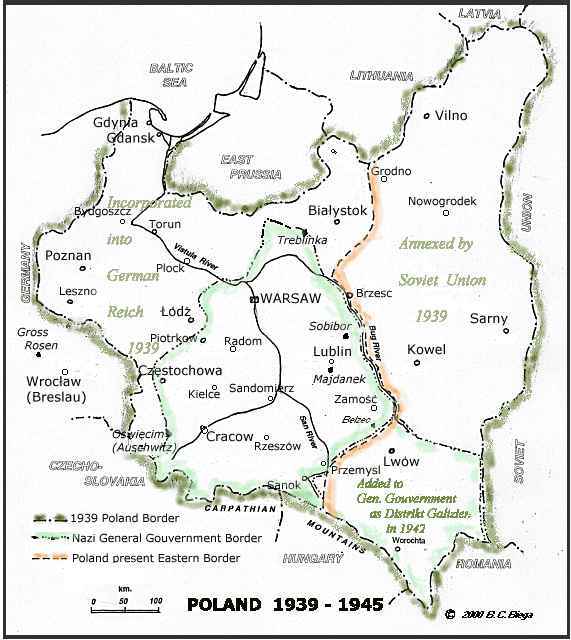
During the years 1939-1941, the main efforts of the ZWZ were directed towards organizational work preparing for later military action. During this period a large number of the independent military groups, that had sprung up after September 1939, were incorporated into ZWZ. At the same time ZWZ was fighting the occupants on three fronts: propaganda, reconnaissance and sabotage. Informational and propaganda activity consists of printing secret bulletins, periodicals and news-sheets which were widely distributed among the population. In addition to the publications of ZWZ and the Delegatura, political parties and various ad-hoc groups were also distributing secret literature. ZWZ was carrying out intelligence activities in occupied Poland as well as in Germany itself. It obtains and sends to London a series of important information, the most important being about the preparations for a German attack against the Soviet Union. ZWZ warned that this attack would come in June 1941; in fact it started June 22. Sabotage activities were directed primarily against economic targets that contributed to the German war effort, industry and transportation. The development of ZWZ was not equally successful in all areas of Poland. In central Poland, which had been made into a separate administrative entity called the "General-Gouvernment" with its capital in Cracow, organization moved along rapidly and work was carried out successfully as planned. The western part of Poland had been incorporated directly into the German Reich, work was much more difficult, better results being obtained in the area of Łódż and Silesia than elsewhere. In eastern Poland the strong Soviet political-police controlled occupation created difficulties that were almost impossible to overcome. In south-eastern Poland, around Lvov, organizational attempts were frequently infiltrated by Soviet spies. In north-eastern Poland, around Vilno and Bialystok efforts were more successful. After the German offensive, these areas fell under strict military and SS control. In early 1942, in the north-east Soviet guerilla units spent as much time fighting Polish units as they did the German enemy. In the south-east, Ukrainian nationalism developed with a strong anti-Polish bias, abetted by the Germans. Consequently, the area of the "General-Gouvernment" was the most fruitful base for conspiratorial activity and planning for a general uprising towards the end of the war.
Return to Top of page.
1942 - 1943: HOME ARMY (AK) IN UNDERGROUND WAR
After Gen. Sosnkowski resigned from the government-in-exile in July 1941 (protesting the Polish-Soviet Military Convention), The Supreme Commander Gen. Sikorski placed ZWZ under his direct control. He issued an order 0n February 14,1942 changing the ZWZ into the "Armia Krajowa - AK" (Home Army), with Gen. Rowecki as Commander. During 1942-43 the unifying campaign had made great progress. The "Narodowa Organizacja Wojskowa" of the National Party and the "Peasant Battalions" of the Peasant Party both subordinated themselves to the command of the Home Army. Now the total number of sworn in members of the AK exceeded 300,000.
With the unqualified support of the civilian population, AK was able to develop increased activities. Secret meetings in small groups allowed stepped up training in accordance with the plans for a future uprising. Secret schools trained officer cadets and non-coms. The development of secret factories of weapons, ammunition and other materials proceeded fast. Radio methods were improved and provided for daily communications between the Home Army Commander and the Chief Delegate and their counterparts in England. The Supreme Commander was able to arrange for air supply from the West to Poland of weapons, and trained specialists for various functions in AK. The Intelligence Service of AK was able to monitor the German army and air force on the Eastern Front, and extended its activities to industry and ports in the Reich. An important success was providing information about the German rocket research in Peenemunde which lead to the successful air-raid of 17-18 August 1943. The diversionary propaganda action among Germans, that had started in 1941, was increased. Its aim was to create confusion and pessimism among the troops and officials of the administration. With London's approval, plans for the future general uprising were prepared. At the same time rules were established for the use of women in the Home Army and in the security forces during the uprising. Gen. Rowecki's ideas about active defense against the occupant included sabotage of all its activities that damaged the economy and the lives of the Polish population. A higher degree of active defense included armed diversions. These caused material damage and at the same time maintained an atmosphere among the population of actively fighting the enemy. Armed actions were carried out by plan - increased or decreased depending upon the general war situation. Towards the end of the war they would lead to the universal uprising.
When the German army was engaged in heavy fighting inside Russia in April 1942, the Supreme Commander issued an order to switch from sabotage to armed diversions. These were directed particularly at the transports to the front. They consisted of destruction of railroad and telephone installations, blowing up bridges, attacking troop trains, warehouses and airfields. They also included actions to free prisoners by attacking prisons and transports, attacks against administration and police personnel, armed actions to defend threatened AK's own installations as well as to receive allied air drops of material and personnel. During this period several hundred such actions took place, mainly in central Poland and the area of Warsaw.
In 1942 the Home Army also started guerilla operations. The first one commenced during the night of December 31, 1942 in the area of Zamosc, where the Germans had started a brutal removal of the Polish population in order to replace them with German farmers. The operation of the partisans in the forests near Zamosc and Krasnobrod lasted until mid-February 1943. The Germans used police and army battalions, tanks and warplanes. At the end of February the Germans dropped their colonization plans. Other large scale partisan operations developed in the forests between Radom and Kielce in central Poland, as well as in the area between vilno and Nowogrodek in the north-east. During 1942-43 the unifying campaign had made great progress. The "Narodowa Organizacja Wojskowa" of the National Party and the "Peasant Battalions" of the Peasant Party both subordinated themselves to the command of the Home Army. Now the total number of sworn in members of the AK exceeded 300,000.
With the unqualified support of the civilian population, AK was able to develop increased activities. Secret meetings in small groups allowed stepped up training in accordance with the plans for a future uprising. Secret schools trained officer cadets and non-comes. The development of secret factories of weapons, ammunition and other materials proceeded fast. Radio methods were improved and provided for daily communications between the Home Army Commander and the Chief Delegate and their counterparts in England. The Supreme Commander was able to arrange for air supply from the West to Poland of weapons, and trained specialists for various functions in AK. The Intelligence Service of AK was able to monitor the German army and air force on the Eastern Front, and extended its activities to industry and ports in the Reich. An important success was providing information about the German rocket research in Peenemunde which lead to the successful air-raid of 17-18 August 1943. The diversionary propaganda action among Germans, that had started in 1941, was increased. Its aim was to create confusion and pessimism among the troops and officials of the administration. With London's approval, plans for the future general uprising were prepared. At the same time the rules were established for the use of women in the Home Army and in the security forces during the uprising. Gen. Rowecki's ideas about active defense against the occupant include sabotage of all its activities that damaged the economy and the lives of the Polish population. A higher degree of active defense included armed diversions. These cause material damage and at the same time maintain an atmosphere among the population of actively fighting the enemy. Armed actions were carried out by plan - increased or decreased depending upon the general war situation. Towards the end of the war they would lead to the universal uprising.
When the German army was engaged in heavy fighting inside Russia in April 1942, the Supreme Commander issued an order to switch from sabotage to armed diversions. These were directed particularly at the transports to the front. They consisted of destruction of railroad and telephone installations, blowing up bridges, attacking troop trains, warehouses and airfields. They also included actions to free prisoners by attacking prisons and transports, attacks against administration and police personnel, armed actions to defend threatened AK's own installations as well as to receive allied air drops of material and personnel. During this period several hundred such actions took place, mainly in central Poland and the area of Warsaw.
In 1942 the Home Army also started guerilla operations. The first one commenced during the night of December 31, 1942 in the area of Zamosc, where the Germans had started a brutal removal of the Polish population in order to replace them with German farmers. The operation of the partisans in the forests near Zamosc and Krasnobrod lasted until mid-February 1943. The Germans used police and army battalions, tanks and warplanes. At the end of February the Germans dropped their colonization plans. Other large scale partisan operations developed in the forests between Radom and Kielce in central Poland, as well as in the area between vilno and Nowogrodek in the north-east.
June 30, 1943, the Home Army suffered a great loss. Gen. Stefan Rowecki was arrested. His deputy, Gen. "Bor" Komorowski took over as Commander of AK, Col. Tadeusz Pełczynski continued on as Chief-of-Staff. After Cyril Ratajski resigned in 1942, Jan Piekałkiewicz (Peasant Party) took over as Chief Government Delegate. He was arrested by the Germans in February 1943 and later died in prison. He was replaced by Jan Stanisław Jankowski (Labor Party). The organization of the Delegatura was enlarged by creating a network of underground civil administration down to county level. The cooperation of the political parties continued in the Political Coordinating Committee, upon which the Delegate depended. It was extended and early in 1944 it was replaced by the Council of National Unity.
Communist elements had been silent during the period of German-Soviet Alliance. They resumed anti-Polish and anti-German activities again after Germany attacked the Soviet Union. A pro-Soviet organization was created under the name Polish Workers Party - "Polska Partia Robotnicza (PPR)", with a military organization called People's Guard, later changed to Peoples Army "Armia Ludowa (AL)".
In 1943 it became clear that Germany was incapable of overcoming the enormous area of the Soviet Union and defeating the Soviet armed forces. The Soviets switched to the offensive on all fronts. It was to be expected that the Germans would retreat under the pressure of the Soviet armies advancing westward across the territory of the Polish republic. It was necessary to decide how the country should behave. Regarding the Germans it was clear - Poland was at war with them and would continue the fight to the end. Russia was also at war with Germany, but entering the territory of Poland would become a danger to Poland's independence. With each victory Russia increased its influence on the decisions of the Allies. Instead of an independent republic they wanted a Polish subservient state organized by them. Poland's situation became tragic.
Return to Top of page.
1944 - 1945; "TEMPEST" - WARSAW UPRISING - DISSOLUTION OF AK
Towards the end of 1943, the government-in-exile in London and the underground government at home make a decision. As the Germans retreat under Soviet pressure, the Home Army will increase its armed fight against them. AK Units fighting against the German army behind the front lines and representatives of the underground civilian government were ordered to reveal themselves to the advancing Soviet Army and present themselves as representative of the Polish Republic and act as hosts in their own country. The code name "Tempest" (in Polish "Burza") was given to this entire action. In addition the preparations for a universal Uprising in the event of a rapid breakdown of Germany were to continue at an increased pace.
"Tempest" lasted throughout 1944, its activities increasing or decreasing in phase with activities on the Eastern Front. It started in south-eastern Poland, in the Wołyn district, where it lasted from January to June 1944. In Bielorus action started June 23 1944, took in the areas of Vilno and Nowogrodek, then spreading to the regions of Białystok, Lublin and eastern Malopolska. At the end of July "Tempest" units crossed the rivers San and Vistula to the areas of Rzeszów and Sandomierz, Radom and close to Warsaw. Later they extended to the region of Cracow and the mountains to the south ("Podhale"). During action "Tempest", AK units of battalion or even regimental size fought dozens of battles with German units. The action of AK in Warsaw has passed to history as the Warsaw Uprising and constitutes a separate chapter.
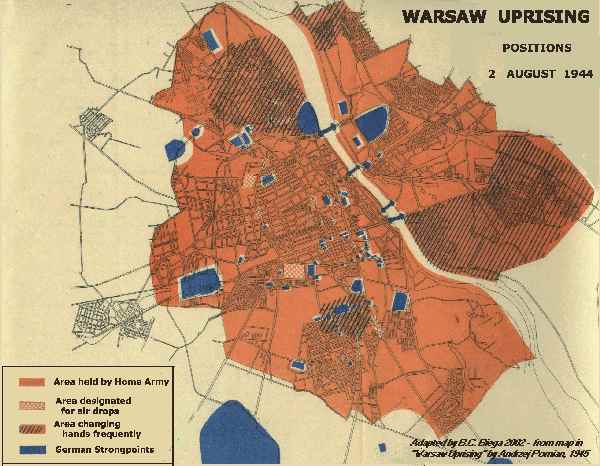
The Soviets behaved in a hostile manner towards the Home Army units. After capturing an area they imprisoned the officers and men and transported them to camps deep in Russia. The Soviets decided to destroy AK and the civilian administration just because they represented the desire of the Polish people for independence. At the end of July 1944 the developments on the Eastern Front indicated an early entrance of Soviet troops into Warsaw. The Commander AK and Chief Delegate, in consultation with the Council of National Unity, determined that the capital city of Poland should be freed from the Germans by the action of Polish soldiers. The government-in-exile in London was advised about the readiness to start the battle.
August 1, at 5 p.m., units of AK under District Commander Col. Anthony Chrusciel "Monter" attacked the Germans simultaneously in the whole city. The enemy suffered considerable losses. Almost the entire city was occupied except for fortified areas defended by strong enemy detachments. Attacks continued for three days, after which the Germans started a strong counter-offensive supported by tanks, heavy artillery and planes. Immediately after fighting started in Warsaw, the Soviets halted their offensive and idly watched the insurgents' battle and the destruction of the city. After two months of struggle, when AK held less than 4 sq.km. in the city center, covered with the ruins of buildings sheltering 1/4 million civilian population, without food, water or ammunition, with no hope of outside intervention, the decision was taken to surrender. The act of surrender was signed October 2, 1944 and fighting halted. 20,000 AK soldiers and officers went to prisoner-of-war camps in Germany. The civilian population, which had fought heroically alongside the soldiers, regardless of age or sex, was evacuated from the city (most of the younger people were taken to work in German factories and farms - translator's note). Before leaving to prison camp, Gen. Bor-Komorowski transferred to Gen. Leopold Okulicki command over the Home Army remaining in the part central Poland still under German occupation. These units continued fighting until January 1945.
After the Soviet armies occupied the remainder of western Poland, based on a decision of the President of Poland (in London), Gen. Okulicki issued an order closing down the Home Army on January 19, 1945. On March 26, 1945, the Chief Delegate Jan Stanisław Jankowski, chairman of the Council of National Unity Kazimierz Puzak and Gen. Okulicki were invited to a meeting with Soviet authorities and were arrested. Transported to Moscow, they were tried with a group of 16 other leaders of the Polish Underground and imprisoned. After the arrests, the director of Internal Affairs in the Delegatura, Stefan Korbonski (Labor Party representative) took over the function of Chief Delegate. On July 1, 1945 the Council of National Unity decided to close the Delegatura and disband itself. By this act the activities of the Polish Underground State came to an end.
# # # # #
written by Tadeusz Pełczynski, translated by B. C. Biega
Return to Top of page.
TRANSLATOR'S NOTES For a complete history of the Polish Underground State from 1939 to 1945, please refer to the book by Stefan Korbonski - "The Polish Underground State 1939-1945" - Columbia University Press, 1978 - ISBN 0-914710-32-X Now out of print - limited availability from Amazon.com - please click on the Amazon icon on the biega.com Home page For a good detailed, but not very long, history of the Warsaw Uprising, please go toT. Kondracki's article at the London Branch of the Polish Home Army Ex-Servicemen Association. For a detailed history of the Warsaw Uprising, including a general discussion of Polish Resistance read "Rising '44 - The Battle for Warsaw" by Norman Davies, Viking Penguin, 2004 - ISBN 0-670-03824-0. You may order at a discounted price, please click on the Amazon icon on the biega.com Home page For some impressions of life in Nazi occupied Poland, the Uprising and prison camp, click here.
Thursday, March 20, 2008
Hubal-Wielka legenda
Hubal-Wielka legenda
Brawo dla autora .. Hubal jest jednym z największych bohaterów Kampani Wrześniowej. Maxymalna ocena
Brawo dla autora .. Hubal jest jednym z największych bohaterów Kampani Wrześniowej. Maxymalna ocena
Subscribe to:
Posts (Atom)